
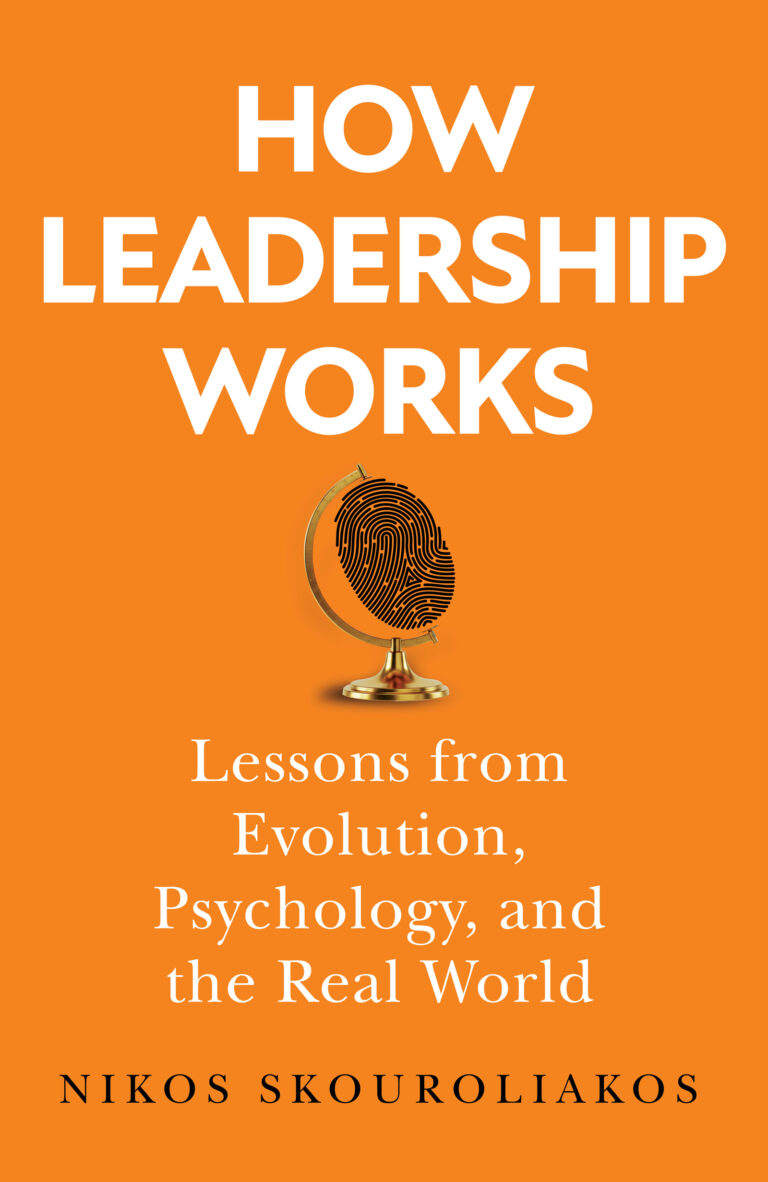
Read this book for free
Create a free AuthorWing reader account to claim your review copy. All we ask is your honest feedback after reading.
Already a reader? Log in
Not ready yet? Get new free nonfiction books by email.
By claiming you agree to our reviewer guidelines.
Leadership predates civilization, predates language, predates the human form. It is not something we invented. It is something we inherited. It ran with wolves, swung with apes, and hunted long before we walked upright.
Most leadership advice tells you what to do. Far less explains why it works.
You’re told to give credit generously. Fine. But why does it work?
You’re told to listen more than you speak. Also fine. But why do people withhold the information you most need, after you’ve promised them it’s safe to talk? Advice without the mechanism is a rule you have to remember. Advice with the mechanism is something you can reason from at four in the afternoon, when the situation in front of you matches nothing you’ve read.
This book supplies the mechanism.
Nikos Skouroliakos spent twenty-five years leading projects across Australia, New Zealand, and Greece—megaprojects, disaster recovery, portfolios worth billions—and kept noticing the same thing. Capable, decent people were being promoted and turning into managers nobody wanted to work for. Not through malice. Through never being told how people actually cooperate. So he went looking, through several hundred books and studies, with supporting sources cited here. What he found starts where human leadership actually began. Not in a boardroom. In small groups, over hundreds of thousands of years, where reading the person in charge was a survival skill and status was worth real risk. That equipment never retired. It’s running in your next meeting—in you as much as in anyone else.
Your team members watch you far more closely than you watch them.
People follow examples long before instructions.
Your smallest inconsistency matters more than the values you preach.
What the book explains:
• Why the same person performs differently under two managers, and how leadership shapes that difference.
• Why the org chart is not the organization, and how to read the one that actually runs it.
• Why you can hit every number and leave the business worse off.
• Why people forget the task and remember the feeling, and what that costs you in turnover.
Read it through, or open it at the problem you have this week.
The goal is not to give you more rules to remember.
It is to help you see.
About the author
Nikos Skouroliakos has spent more than twenty-five years leading teams and delivering complex projects across Australia, New Zealand, and Europe.
A structural engineer by training, with an MSc in Management in Construction, he has spent his career working on high stakes environments where understanding people matters just as much as mastering the technical details. People remain the most interesting—and least predictable—part of the job.
Along the way, he became fascinated by a simple question: why do some leaders bring out the best in people, while others bring out the worst?
His search for answers led him into psychology, behavioural science, and human evolution. How Leadership Works grew out of that curiosity, combining what the research tells us with lessons learned from working across cultures and continents.
